
5G Is Everywhere Now — Here's What That Actually Means for You
5G rollout is nearly complete in most cities. The promises were enormous. What actually changed, what's still coming, and what was exaggerated.
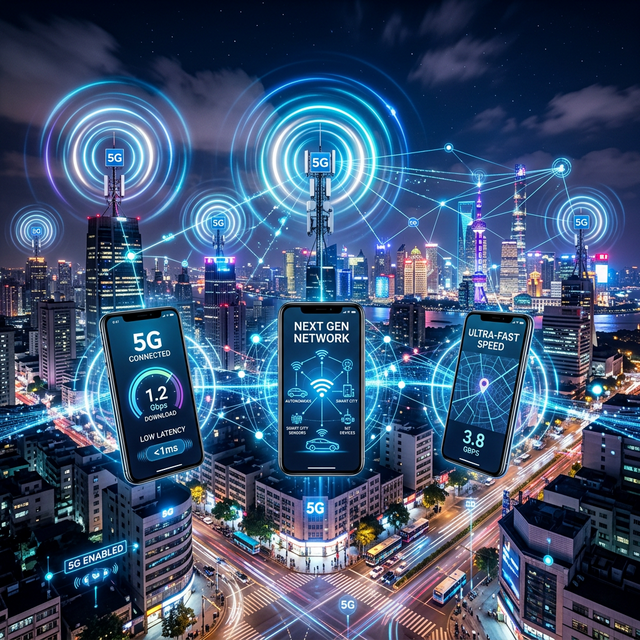
TL;DR — Key Takeaways
- •Real Speed: 5G is 10-20x faster than 4G in dense areas, with latency as low as 1ms.
- •Industrial Boom: Private 5G networks are transforming manufacturing, mining, and healthcare robotics.
- •Consumer Reality: Better streaming and stable calls now; revolutionary apps (AR, autonomy) still arriving.
5G was supposed to enable self-driving cars, remote surgery, and smart cities by 2022. It's 2025 and I'm mostly using 5G to stream videos on the subway slightly faster. So what happened?
The short answer: infrastructure takes time, but the fundamentals are solid and the real applications are now arriving.
What 5G Actually Delivers
Speed improvements are real and meaningful. In areas with dense 5G coverage, average speeds run 10-20x faster than 4G. Downloading a full HD movie takes seconds instead of minutes. Video calls are noticeably more stable. In crowded venues — stadiums, concert halls, airports — where 4G ground to a halt, 5G handles the load.
Latency is the more interesting technical improvement. 5G latency can be as low as 1 millisecond compared to 40-60ms for 4G. For most consumer applications this doesn't matter. For industrial and real-time applications, it's transformative.
5G Key Statistics (2025)
Industrial 5G: Where It's Actually Exciting
Manufacturing is being transformed by private 5G networks. Factories deploy their own 5G infrastructure connecting thousands of sensors, robots, and machines with real-time precision. BMW, Volkswagen, and Siemens all run production 5G factory networks. The result: machines communicate fast enough for real-time quality control and coordination that was impossible with previous connectivity.
Remote-controlled heavy machinery is working commercially. Mining companies operate equipment from control rooms thousands of kilometres away. The latency and reliability of 5G makes this viable where 4G couldn't. Operators stay safe, equipment runs more hours, and the economics work.
Healthcare remote surgery pilots are running. Surgeons have performed procedures over 5G networks with robotic assistance, the connection stable enough to handle the precision required. Still experimental, but the technical barrier is being cleared.
📖 Related Deep Dive
For more on how technology is reshaping transportation, read: Electric Vehicles in 2025: The Numbers Have Finally Changed Everything
For Regular People Right Now
The practical benefits for consumers are noticeable but not revolutionary — yet. Better streaming in crowded places. Faster downloads. More stable video calls. If you're in a major city, you probably notice 5G working well without thinking much about it.
The consumer revolution comes when devices lean into the connectivity. AR glasses that stream rich data overlays need 5G bandwidth. Truly autonomous vehicles — not driver assistance, actual autonomy — need 5G as a backbone. Cloud gaming that feels truly local needs 5G latency.
5G vs 4G: Speed & Latency Comparison
| Specification | 5G | 4G |
|---|---|---|
| Peak Speed | 10-20 Gbps | 1 Gbps |
| Latency | 1ms | 40-60ms |
| Device Density | 1M/km² | 100K/km² |
| Real-World Speed | 10-20x faster in dense areas | |
What Was Overhyped
The "5G will connect your smart refrigerator" narrative was mostly marketing. Most IoT devices don't need 5G — 4G, WiFi, or even narrowband networks serve them fine. 5G solves problems that require extreme speed or extremely low latency from mobile connections.
Coverage claims were also stretched. Early 5G maps showed vast coverage that was actually millimetre-wave 5G — extremely fast, with a range of about 100 metres and blocked by walls. Sub-6GHz 5G has better range and coverage but more modest speeds. Both matter, both have different use cases.
The Next Three Years
5G Standalone networks — which unlock the full feature set — are being deployed now. Slice networking (dedicated network slices for specific applications with guaranteed performance) is rolling out commercially. This is when the industrial and specialised applications really take off.
The foundation is built. The applications built on it will define the next decade.
Frequently Asked Questions
Is 5G really faster than 4G in everyday use?
What is the difference between millimetre-wave and Sub-6GHz 5G?
How is 5G used in manufacturing?
Marcus Vance
Telecommunications Analyst & Tech Journalist. Reporting on network infrastructure, 5G deployment, and the future of connectivity. Learn more →